FlowRunner vs n8n
FlowRunner vs n8n: FlowRunner covers the same automation no-code, with human oversight and built-in compliance; n8n adds developer code and free self-host. How to choose.
TL;DR
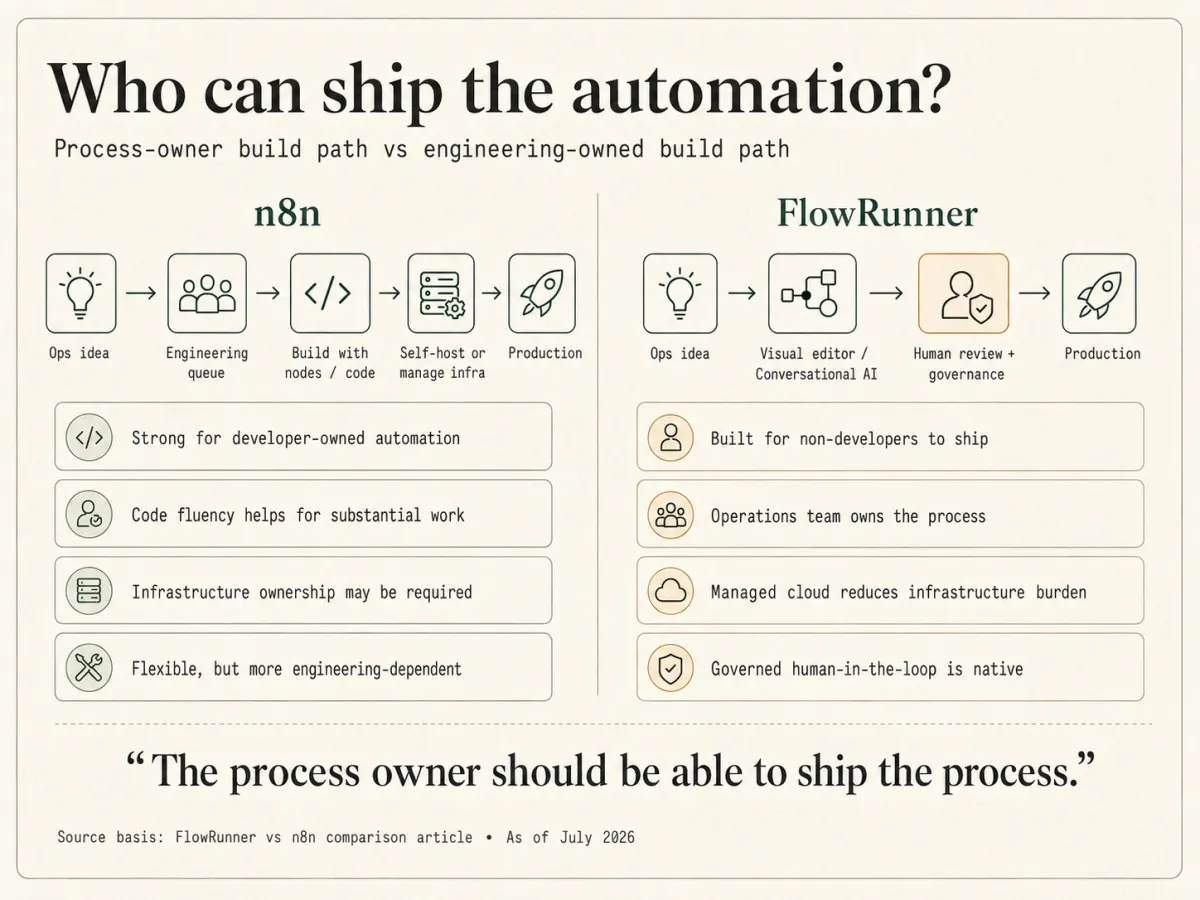
- Start with the automation both run: connector-based, trigger-to-action flows, now with AI agents and human-in-the-loop on top. FlowRunner runs all of it, and the operations team that owns the process ships it without an engineering bottleneck or compliance to bolt on. FlowRunner is Orchestration as a Service, built so non-developers ship production agents. What n8n adds is a more permissive code surface (a full JavaScript or Python runtime with npm and network access, beyond FlowRunner’s sandboxed Custom Cloud Code) and free unlimited self-hosting today.
- This page is about AI-agent automation with human oversight. For that specific work the fit is not 50/50: FlowRunner is built for it, and n8n is reached through developer ownership of code and infrastructure. We will still show you exactly where n8n is the better call, because sometimes it is.
- FlowRunner is stronger where this reader lives: operations-team accessibility for non-developers, human-in-the-loop as a native agent tool on every tier, compliance with a BAA at mid-tier prices, and agent-tool metadata on every action across a verified catalog.
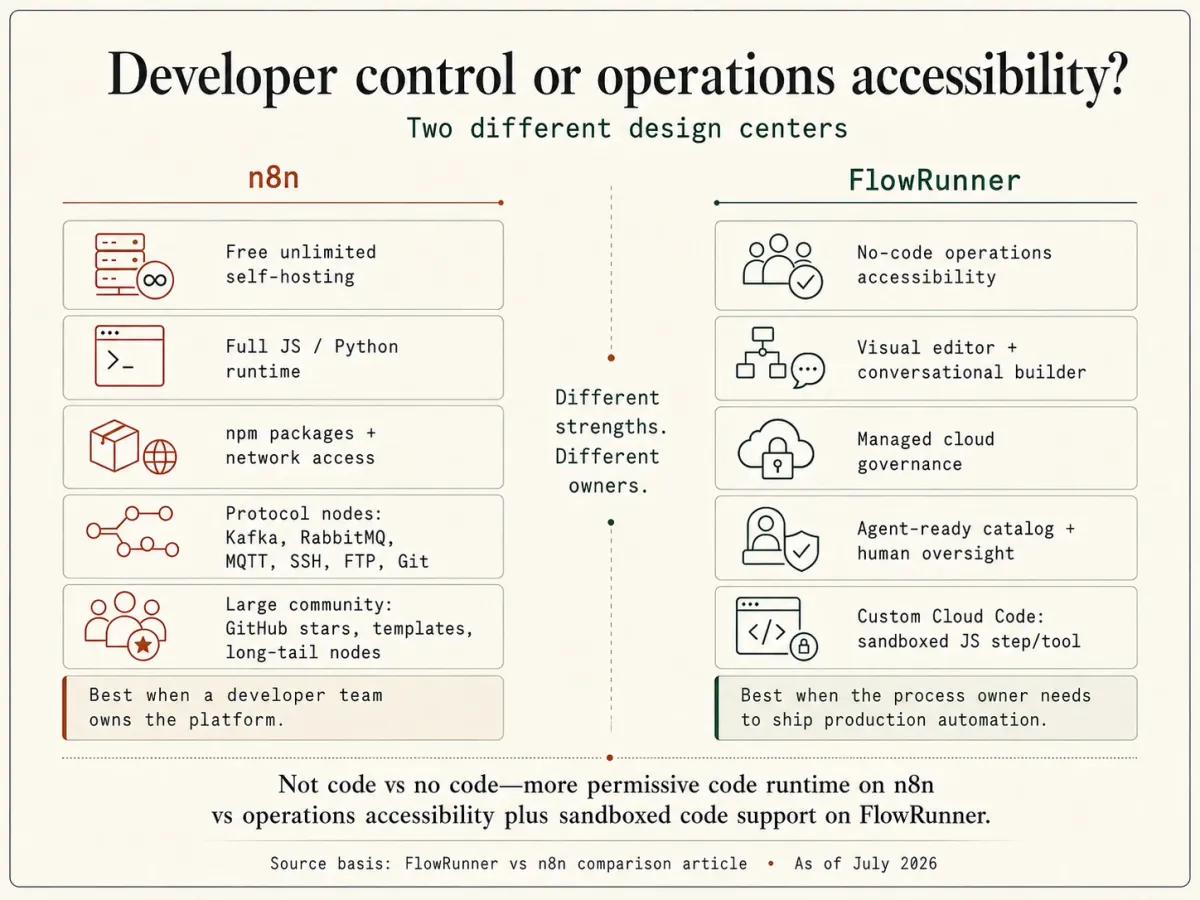
- n8n is stronger on free unlimited self-hosting, a more permissive code runtime (JavaScript or Python with npm and network access, where FlowRunner runs sandboxed Custom Cloud Code), its GitHub community and template library, fair-code control, and a handful of protocol-level nodes (message brokers, SSH, FTP, Git) FlowRunner does not yet cover.
Who this comparison is for
You are building AI-agent automation where the agent has to do more than fire a linear sequence and finish. It needs to stop and pull in a person when the rules do not cleanly apply. It may touch data an auditor will ask about later. And it needs to get built and maintained by the team that owns the process, whether or not that team writes code. You might be a COO, VP of operations, or operations director at a 50-to-500-person company, coming from n8n or starting fresh, deciding which platform is built for that work.
The overlap is large: the connector-based, trigger-to-action automation n8n runs, FlowRunner runs too, with AI agents and human-in-the-loop on top, and the operations team ships it without an engineering bottleneck or compliance to bolt on. What n8n adds is a more permissive code surface (a full JavaScript or Python runtime with npm and network access, beyond FlowRunner’s sandboxed Custom Cloud Code) and free unlimited self-hosting today. This page is about where those facts leave you: the agent that hits an automation exception it should not decide alone and has to hold the run open until a human answers.
What FlowRunner is good at
FlowRunner is built around one commitment: agents that know when to stop and ask a human for help, built by the team that owns the process rather than by an engineering group they have to queue behind. Everything else in the platform exists to make that commitment reliable at production scale.
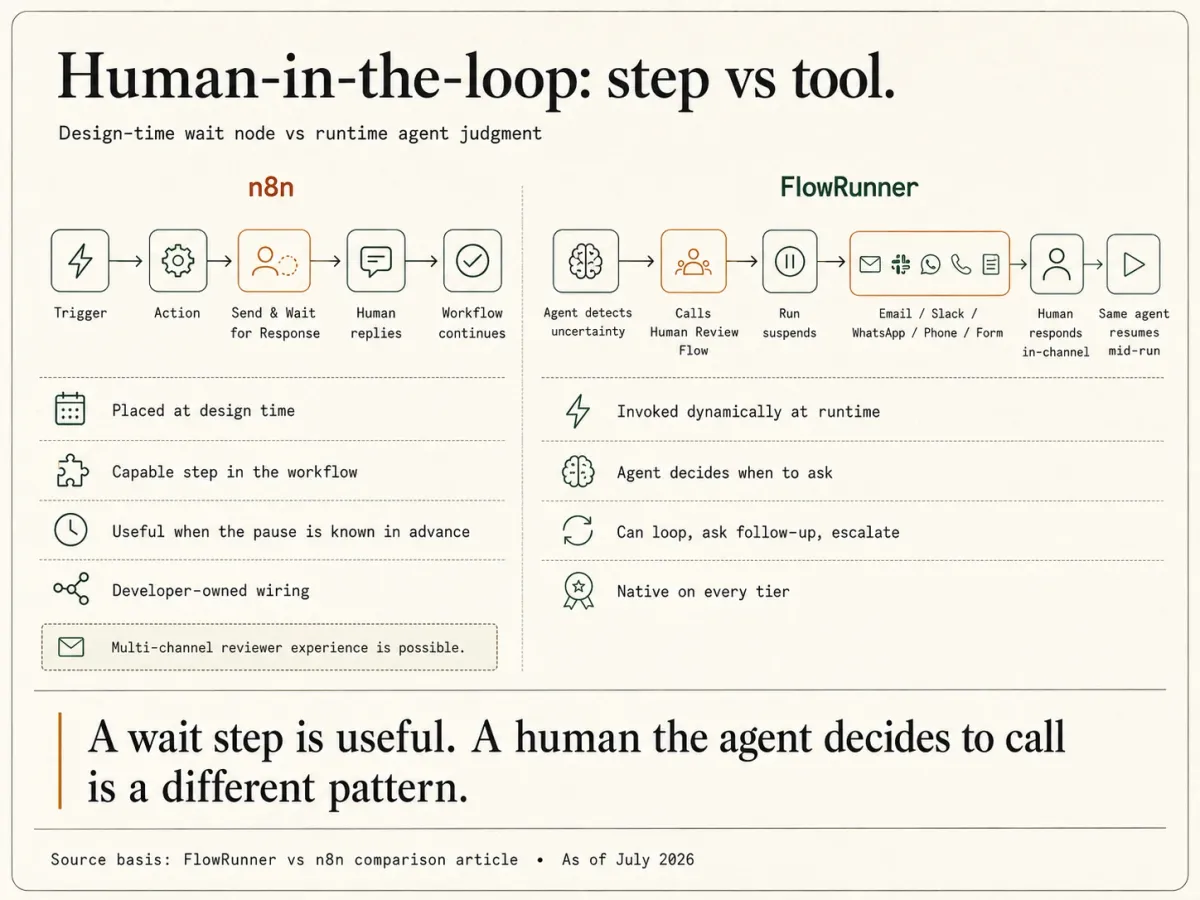
The mechanism is the part that a wire-in approval node does not have. In FlowRunner, an AI agent invokes one of your own Flows as a callable tool. When the agent calls that flow-tool, it suspends while the flow runs, and the flow can hold on an external callback until a human replies through email, Slack, WhatsApp, phone, or a Form, then resume mid-run. This is human-in-the-loop as an execution pattern: the agent pauses on its own judgment, assembles the context and the choices available, routes to a human on their preferred channel, and resumes the moment they answer. Some teams call it a digital andon cord, after the Toyota factory pull cord any worker can pull to stop the line when something needs a human eye.
FlowRunner is strong on:
- Operations-team accessibility. The platform is designed so the people who own the process build the automation. The visual editor and the Conversational AI mode let an operations director ship a working, production agent without a JavaScript primer and without owning the infrastructure it runs on. Describe the agent you want in plain language and the Conversational AI assembles it, then hands off to manual fine-tuning at any point.
- Human-in-the-loop as an agent tool. The agent decides at runtime to pull in a person, calls a human-review flow as a tool, and suspends until they reply in their own channel: email, Slack, WhatsApp, phone, or a Form. It can loop over a batch, ask a follow-up question, and escalate if no one answers. The pause is decided by what the agent sees, not fixed at design time. It is native on every tier starting at Growth ($45/month).
- Compliance with a BAA at mid-tier prices. Audit trails, SLA tracking, and RBAC start at the Professional tier ($299/month), and HIPAA support with a BAA is available. SSO/SAML and 90-day audit retention arrive at Business ($999/month). For a regulated mid-market buyer, the compliant configuration lives at mid-tier rather than behind an Enterprise negotiation.
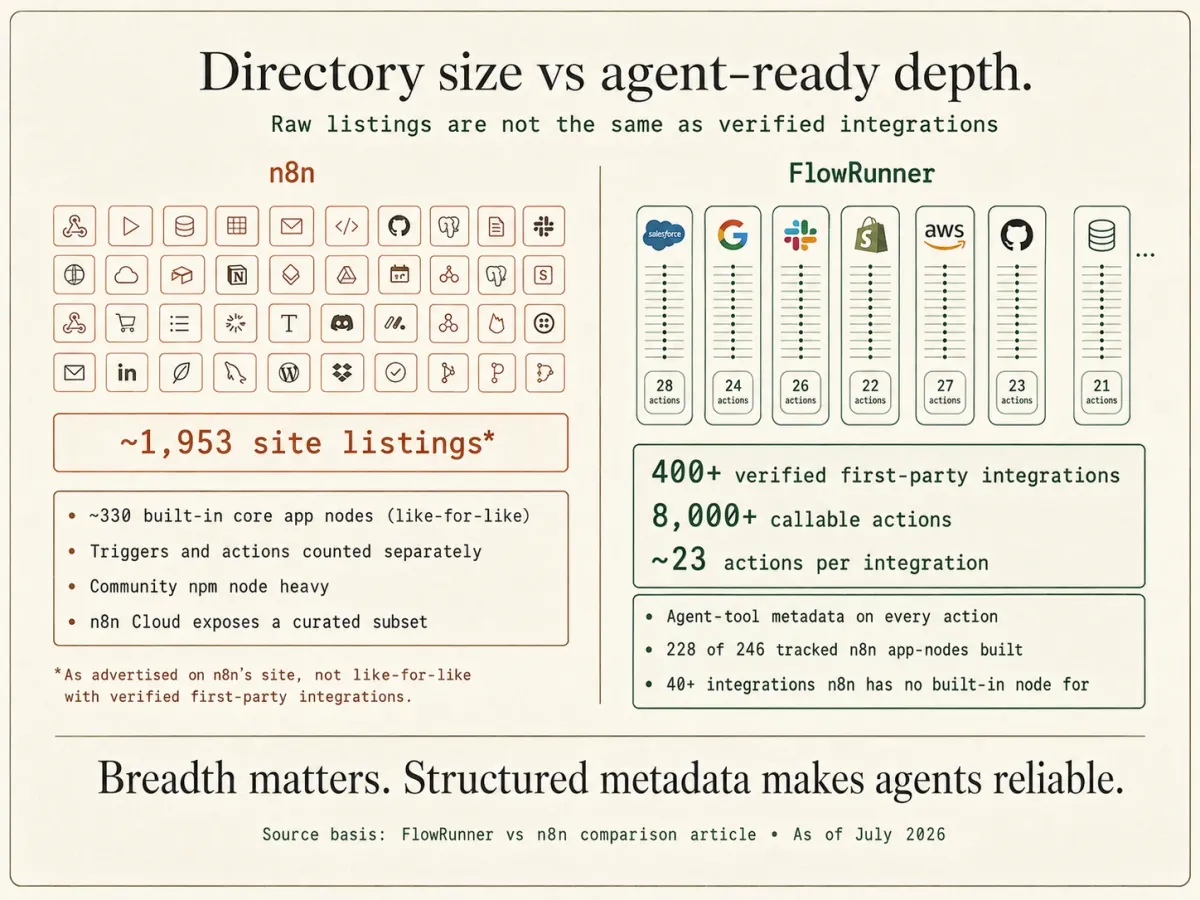
- A verified, agent-ready catalog with depth. 400+ verified integrations and 8,000+ callable actions (as of July 2026, and growing), roughly 23 actions per integration, each carrying the structured metadata an LLM needs to call it as a tool, all built and verified against each vendor’s official API.
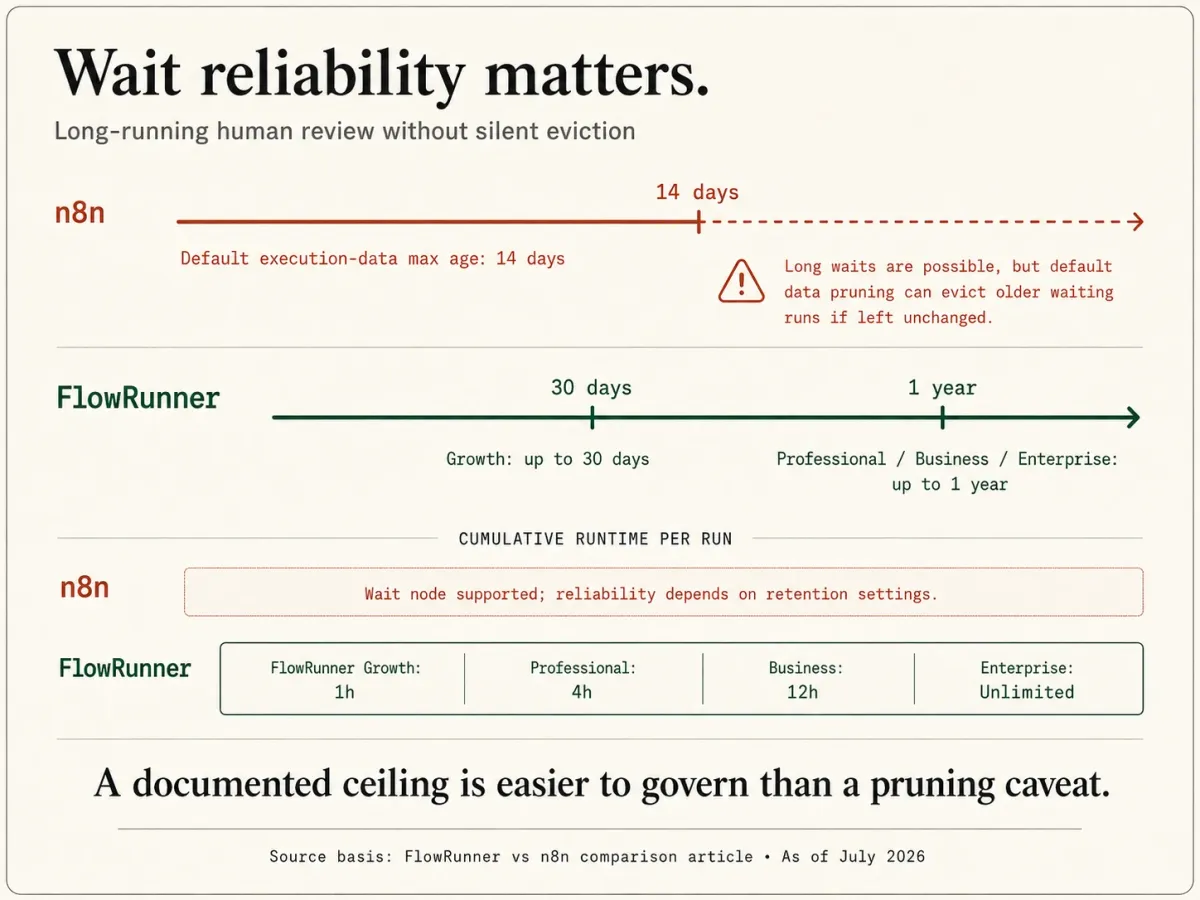
- Long waits and long runtimes. A run can suspend for up to 30 days on Growth and up to a year on Professional, Business, and Enterprise. Cumulative runtime runs to 1 hour on Growth, 4 hours on Professional, 12 hours on Business, and unlimited on Enterprise.
- BYOK with no markup. BYOK is a model where the customer supplies their own AI provider API credentials, pays providers directly for usage, and FlowRunner orchestrates calls across providers without taking a markup on inference. For a buyer who already has an Anthropic, Google, or Azure agreement, that means your own rates, your own data-processing terms, and a provider your security team already approved.
That pause-for-a-human moment, invoked by an agent an operations team can build, is the load-bearing part of FlowRunner’s architecture. It is why agentic work that needs human judgment is native here rather than assembled from workarounds or handed to an engineering team.
What n8n is good at
n8n has built one of the widely used workflow automation platforms in the market, with a developer-first design and a mature self-hosted deployment model. The credentials it cites are large: approximately 192,000 GitHub stars, 200,000+ community members, and a funding history that runs from a $180 million Series C in October 2025 (Accel-led, $2.5 billion valuation) through a strategic investment from SAP in May 2026 at a $5.2 billion valuation, for $254 million in total funding. The community is large and the documentation is thorough.
n8n is strong on:
- Free unlimited self-hosting. n8n’s self-hosted Community edition runs unlimited executions for free under its fair-code license, and self-hosting is the flagship deployment model rather than an afterthought. FlowRunner Cloud does not match a $0 unlimited self-host on sticker. Two things sit alongside that free number: self-hosting carries the operating cost of running the infrastructure yourself, which industry estimates put into six figures a year for a maintained production deployment once you count servers, upgrades, and DevOps time, and n8n Cloud signs no BAA, so a regulated team on the free self-host path owns all of its own compliance.
- A large, code-extensible node ecosystem. n8n’s directory advertises ~1,953 listings, though that number counts triggers and actions separately and is dominated by community-maintained npm nodes, and n8n Cloud exposes a curated subset; for anything unlisted, its generic HTTP node lets a developer wire up any REST API by hand. That breadth-via-community-and-code model is a genuine fit for a developer team that will extend the platform itself. On a like-for-like, first-party basis the two are close, and FlowRunner is slightly ahead: n8n’s roughly 330 built-in core app nodes against FlowRunner’s 400+ verified integrations, covered in the sections below.
- A more permissive code surface. n8n’s Code node runs JavaScript or Python in a full runtime, with npm packages and network access, at any point in a workflow. FlowRunner also runs code: its Custom Cloud Code block executes JavaScript as a step, and can be handed to an AI agent as a tool it calls on its own. The difference is the sandbox: FlowRunner’s runs JavaScript only, with no npm or direct network (I/O goes through the HTTP Request and database blocks), and caps execution at ten seconds. For a developer team that wants an unrestricted runtime with any package, n8n’s node is more permissive today, though FlowRunner is adding custom actions with arbitrary JavaScript, shipping in August 2026.
- A large developer community and template library. With approximately 192,000 GitHub stars, 200,000+ community members, a several-year head start, and a homepage that lists 9,500+ community templates, n8n has a bigger community and a richer template ecosystem than FlowRunner does today. For a developer starting cold, that head start on ready-made examples is real. FlowRunner’s answer is a growing catalog of install-and-configure packages, but n8n’s community library is larger right now.
If your team is developer-owned and wants to host and extend the platform with code, those strengths line up with how you work.
Where FlowRunner is stronger
For the agentic, human-oversight work this page is about, built and maintained by an operations team, these are the differences that decide the platform:
- Operations team can build and maintain. This is the largest practical difference for the buyer this page is written for. n8n’s design assumes developers will own the platform: the visual editor is forgiving for simple flows, but the platform expects code knowledge for anything substantial, and self-hosting expects infrastructure ownership. FlowRunner is built so the operations team that owns the process owns the automation, no engineering bottleneck and no translation between business logic and JavaScript. The Conversational AI builder, which assembles an agent from a plain-language description, has no n8n equivalent today.
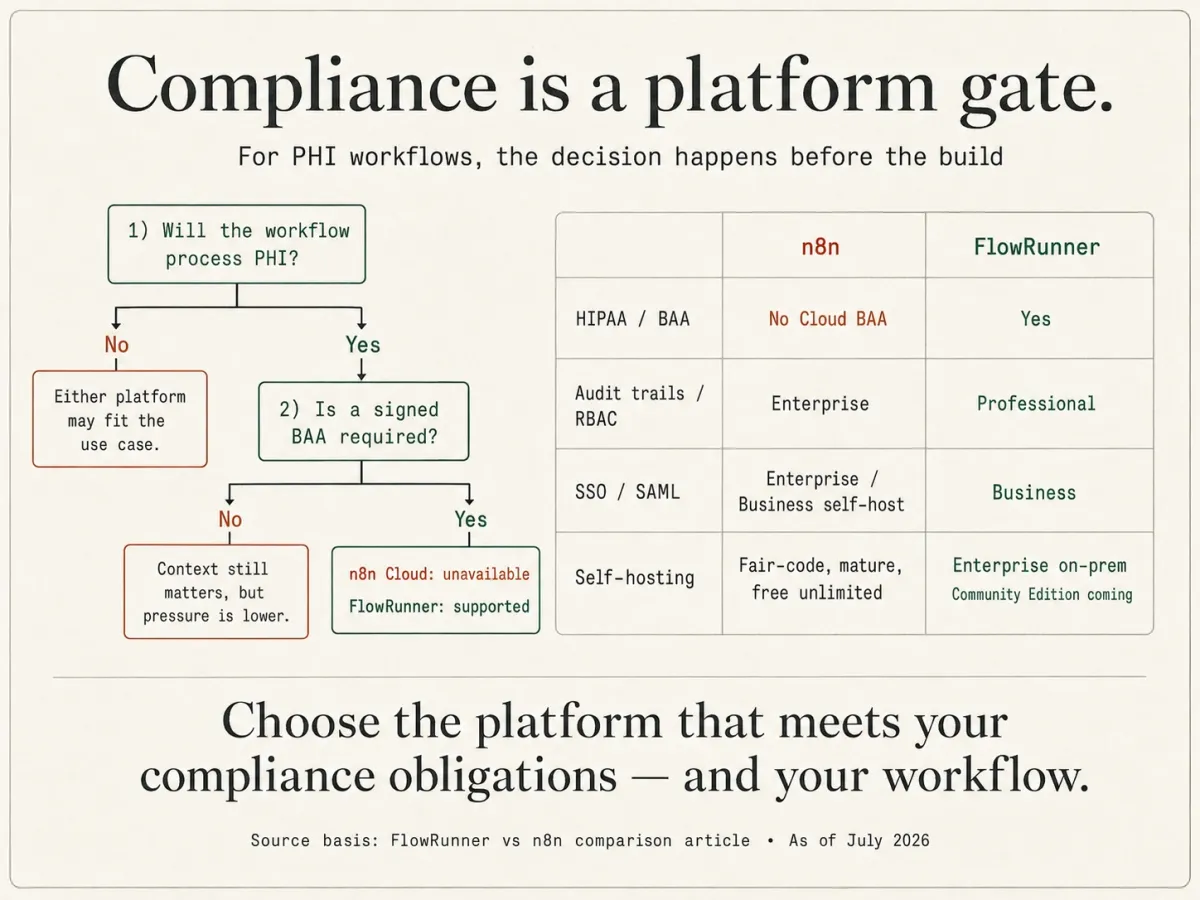
- Compliance with a BAA at mid-tier prices. FlowRunner ships audit trails, SLA tracking, and RBAC, with a BAA available, starting at Professional ($299/month). n8n has no Cloud BAA at any price, and gates SSO/SAML, RBAC, and audit streaming to its custom-priced Enterprise tier, with the Community edition offering essentially no multi-user governance. A regulated team on n8n ends up either negotiating Enterprise or self-hosting and owning all of its own compliance. For a 100-person healthcare or financial services company, that difference can drive the decision on its own.
- Human-in-the-loop as an agent tool. n8n’s human-in-the-loop is its Send and Wait for Response node: the workflow reaches the node, sends a message across a channel, and waits for an approval, free-text, or form reply. It is a capable step, and it is placed in the workflow at design time. FlowRunner works differently. The agent itself decides at runtime to pull in a person, calls a human-review flow as a callable tool, and suspends until they reply. The pause condition is decided by what the agent sees rather than fixed in the wiring, the context delivered to the human is assembled rather than pasted, and the flow can loop, ask a follow-up, and escalate. That is the difference between a wait step you place in advance and a human the agent decides to call at runtime.
- Wait ceilings without silent eviction. Both platforms can suspend a run for a person who takes days to answer. n8n’s Wait node carries a data-pruning caveat: the default 14-day execution-data max age can evict a longer-waiting run, a failure mode that is easy to miss. FlowRunner suspends a run for up to a year on Professional and above as a documented ceiling, with no equivalent pruning risk. For work that waits on a person who might take a week, that difference in reliability matters.
- Depth per integration, with agent-tool metadata. FlowRunner’s 400+ integrations span 8,000+ actions, roughly 23 per integration, and every action carries typed parameters, descriptions, and sample output so an agent can call it as a tool directly. Full-CRUD databases and deep ERPs are in the catalog, and every action is agent-ready by default rather than being a workflow node an agent has to be wrapped around. n8n’s directory lists more entries overall, but they are workflow nodes without that metadata; on verified first-party integrations FlowRunner is ahead (400+ against n8n’s ~330 built-in core app nodes), and every FlowRunner action ships the structured metadata an agent needs to invoke it directly.
- Composability across agents. An agent assembled in the Agent Factory can call other agents and existing flows as tools. The unit of composition is an agent, not a workflow node, and the Code of Conduct provides platform-enforced governance for how agents communicate, escalate to humans, and produce audit trails across many agents from many authors. n8n’s composability stays at the workflow level, with no equivalent inter-agent governance layer today.
Where n8n is stronger
This is the section most comparison pages skip. n8n wins on real dimensions, and if these are your priorities, n8n is the right call.
- Free unlimited self-hosting, available today. n8n’s self-hosted Community edition runs unlimited executions for free, and its self-hosting is mature and flagship, which FlowRunner does not match today (its Enterprise on-prem option exists, but the free Community Edition is still coming). The free number comes with the operating cost of running it yourself, into six figures a year by industry estimates for a maintained production deployment, and no Cloud BAA, so it does not clear a regulated use case on its own. But for a team with the DevOps capacity and no compliance requirement, free unlimited self-hosting is a genuine advantage n8n has and FlowRunner does not.
- Message brokers, protocol nodes, and the community long tail. This is where n8n’s node set genuinely reaches further. n8n has built-in nodes for the Kafka, RabbitMQ, and MQTT message brokers and for core SSH, FTP, and Git, which FlowRunner does not yet cover (SFTP is on the roadmap). For a genuinely obscure service, n8n’s community-node long tail or its generic HTTP node may reach it when FlowRunner’s verified catalog does not. This is not a raw-count story: on verified first-party app integrations FlowRunner is ahead (400+ against n8n’s ~330 built-in core app nodes), and n8n’s advertised ~1,953 counts triggers and actions separately and is community-dominated. It is about those specific protocol nodes and the community tail. If one of them is your single deciding factor, n8n probably has it and FlowRunner may not.
- A more permissive code runtime. n8n’s Code node runs JavaScript or Python in a full runtime with npm packages and network access. FlowRunner runs code too: its Custom Cloud Code block executes sandboxed JavaScript and can be handed to an agent as a tool, with custom actions arriving in August 2026. But n8n’s runtime is more permissive today: Python, external packages, and network calls from the code itself. For a team that wants unbounded code with any library and owns the engineers to use it, n8n is the more permissive platform.
- A large developer community and template ecosystem. n8n’s community, its 9,500+ community templates, and its several-year head start give a developer starting cold a large library of examples and answers. FlowRunner’s community is much smaller today. For a team that values that established ecosystem, n8n’s is larger right now.
- Fair-code licensing and developer control. Some buyers will not deploy proprietary platforms, or want to fork and extend the code, or need to self-host without a commercial contract. n8n’s fair-code model (its Sustainable Use License restricts reselling n8n commercially, but permits self-hosting freely) is the cleaner answer for those teams. FlowRunner offers a free Community Edition for self-hosting, but it is proprietary and still coming.
If any of those outweigh the differences above, n8n is the right call, and choosing it is defensible.
Feature comparison
| Dimension | FlowRunner | n8n |
|---|---|---|
| Primary buyer | Operations team plus builder | Developer / platform team |
| Who builds and maintains | Operations team, no code required | Developer team, code and infrastructure ownership |
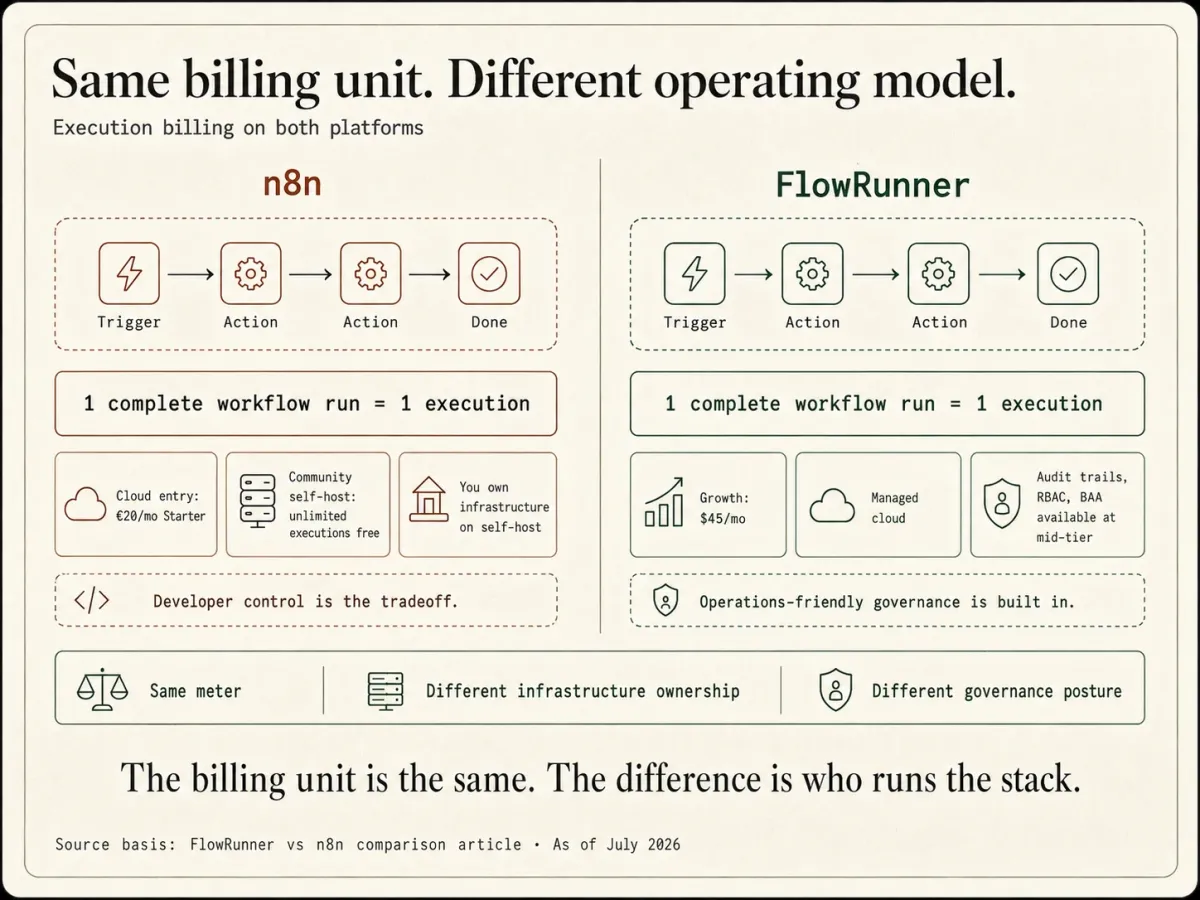
| Billing unit | Execution (one whole run) | Execution (one whole run); Community self-host unlimited free |
| Visual builder | Yes (operations-oriented) | Yes (developer-oriented) |
| Conversational AI builder | Yes | No |
| Custom code | Custom Cloud Code (sandboxed JS, agent-tool); custom actions ~Aug 2026 | Code node: JavaScript/Python, npm, network |
| AI agents | Native (Agent Factory) | AI Agent node (LangChain) |
| Human-in-the-loop | Native every tier; agent-invoked callable tool; can loop, branch, escalate | Send and Wait for Response node (design-time step) |
| HITL reviewer experience | Reply in-channel: email, Slack, WhatsApp, phone, Form | Slack, Gmail, Email, Teams, Telegram, Discord, WhatsApp, Chat |
| Max native wait | 30 days Growth, up to 1 year other tiers | Wait node; 14-day execution-data pruning can evict longer waits |
| MCP | Consumes external MCP servers; exposes catalog as MCP server (shipping ~Aug 2026) | Native (server trigger + client) |
| Integration directory | 400+ verified first-party, 8,000+ actions (~23 each) | ~330 built-in core app nodes (site lists ~1,953, community-heavy) |
| Mainstream app coverage | Parity: 228 of 246 tracked n8n app-nodes built, plus 40+ n8n lacks | Broadest node list overall |
| Agent-tool metadata on actions | On every action | Not the model |
| Cloud entry price | $45/mo Growth (12,000 executions) | €20/mo Starter |
| Free evaluation | $100 credit (~2 months on Growth) | Free Starter and Pro; unlimited free self-host |
| HIPAA / BAA | HIPAA with BAA available | No Cloud BAA (self-host + own BAAs only) |
| Audit trails / RBAC | Professional ($299) | Enterprise (custom) |
| SSO/SAML | Business ($999) | Enterprise (custom); Business €667 self-host has SSO |
| Self-hosting | Enterprise on-prem; Community Edition coming | Fair-code, mature, free unlimited executions |
| BYOK for AI | Yes, no markup on inference | No native BYOK model |
| Inter-agent governance | Code of Conduct | No equivalent |
| SOC 2 | Security program designed to meet common audit requirements | Yes |
Decision framework
Pick FlowRunner if:
- Your agents need to stop and pull in a human mid-run, and the human might take hours or days to answer, and you want that pause decided by the agent at runtime rather than wired in as a fixed step.
- The operations team that owns the process needs to build and maintain the automation without an engineering bottleneck or a JavaScript primer.
- You handle regulated data and need HIPAA with a BAA, audit trails, and RBAC at mid-tier prices, which n8n Cloud cannot provide at any price.
- You want every action in the catalog callable by an agent as a tool, with the depth and the metadata to make that reliable.
- The buyer in your organization is a COO, VP of operations, or operations director, not a CTO.
Pick n8n if:
- You have a developer team that owns automation as part of its job and wants to write and control the code.
- Free unlimited self-hosting is your priority, you have the DevOps capacity to run it, and you do not need a Cloud BAA.
- You need the broadest node list, including message brokers and core SSH, FTP, or Git, or a specific long-tail or community-contributed node today.
- An unrestricted code runtime is non-negotiable: Python, npm packages, or network calls from the code itself, beyond FlowRunner’s sandboxed Custom Cloud Code.
- Fair-code licensing matters to your procurement or technical leadership, or you plan to fork and extend the platform.
If the answer is honestly mixed, run a real workflow on both before committing. The right platform is the one that fits how your team actually works, not the one with the larger node directory.
Migration considerations
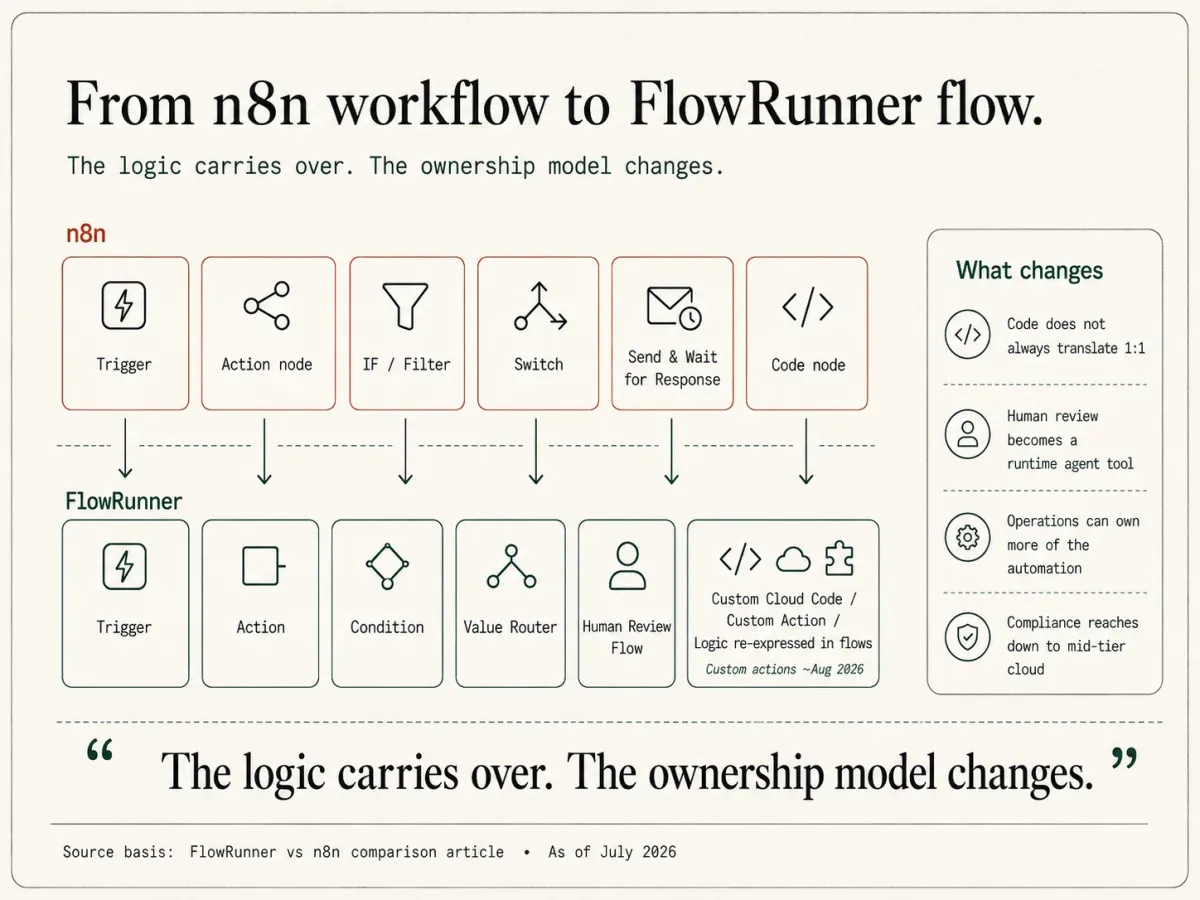
For teams already on n8n and weighing a switch, the practical questions:
- What maps mechanically? Triggers, actions, and basic flow structure usually map directly. Most n8n app nodes have a FlowRunner action equivalent, and the step structure carries over.
- What gets re-expressed? JavaScript in n8n custom nodes does not always translate node-for-node. Logic that lived in code becomes business logic in FlowRunner flows, a Custom Cloud Code block, or a custom action. The Send and Wait for Response node becomes an agent-invoked human-in-the-loop Flow that the agent calls at runtime and that reaches more channels.
- What gets better in the process? The team’s relationship to the automation changes: the operations team owns it instead of engineering. A human step wired in at design time becomes a pause the agent decides on at runtime, and a compliant configuration reaches down to mid-tier instead of Enterprise.
- What stays the same? Your integrations with third-party systems mostly stay the same. We connect to the same Salesforce, the same QuickBooks, the same Slack workspace.
- Who runs the migration, and how long? The Midnight Flow consulting team runs migrations as part of FlowRunner Enterprise onboarding, and other tiers self-migrate with the platform’s import tools. A typical mid-market deployment with 20 to 50 active workflows migrates over 4 to 8 weeks with consulting support, or longer self-served.
If you would like a free migration consultation, reach out via the Contact page and we will scope the engagement before any commitment.
Ready to automate this?
Start building your first workflow free. $100 in credits, no card required.